From floods in Nepal to five years of healing in Kalimpong
October started with floods in Nepal and ended with India's lab animals on the line. In between, our partners kept doing the steady work that rarely makes the news: sterilising dogs, treating the sick and injured, teaching children kindness, and giving rescued animals a life worth living.
Here's what October looked like.
Nepal: A Second Flood, and a Dog Who Couldn't See It Coming
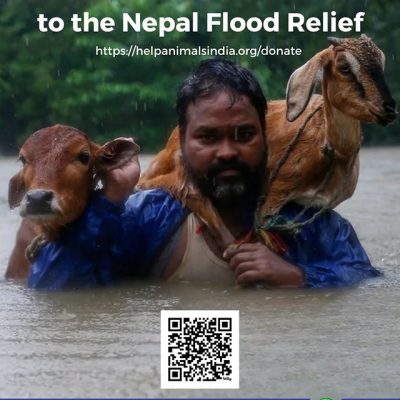
On the morning of 11 October, a wall of black mud, rocks and water tore down the Budhigandaki river in Gorkha. A landslide is believed to have blocked a stream high in the mountains near Chhekampar, and when it burst, the surge swept through the villages below. Early reports counted 45 houses destroyed, 34 livestock sheds damaged and several bridges washed away. Five people from Chumchet who had gone to tend their sheep were missing, and the area was cut off by road.
Animal Nepal knows these mountains well. With the help of Help Animals India and others, the team has worked in the Tsum Nubri Valley since 2024 and in the wider Gorkha region since 2017, caring for dogs and for the horses, mules and donkeys that remote communities depend on. They stayed in close contact with the rural municipality and Gorkha Veterinary Hospital as the situation unfolded. It was the second major flood in Nepal in under two months, after the Bhotekoshi floods in August.
In Kathmandu, Sneha's Care met a different kind of disaster. Fuchhi is blind. The team first knew her from regular feeding visits to a squatter settlement in Balkhu, where she got by because she knew every corner of the place she called home. Then the settlement was demolished. With her family gone and the streets she knew flattened, she faced traffic she couldn't see and dangers she couldn't learn fast enough. Sneha's Care brought her into their care.
When people lose their homes, the animals who lived alongside them often lose everything too, and those with a disability have the hardest time. Fuchhi needed someone to notice her.
Help us stand with our partners in Nepal
Varanasi: 28,278 Dogs and Counting
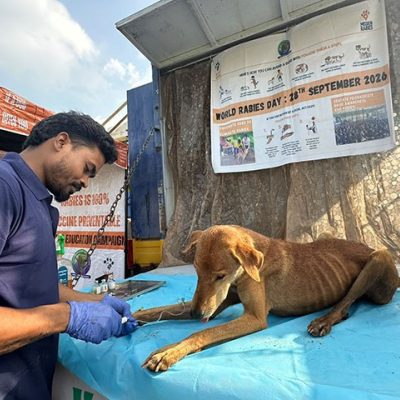
Since 2019, Varanasi for Animals (VFA), a Help Animals India project, has sterilised 28,278 street dogs in and around Varanasi. The team has kept going year after year: 3,487 in 2019, a peak of 9,095 in 2021, and 2,087 more between January and August this year alone. Over the same period, VFA treated 2,158 sick and injured animals.
Each of those surgeries is one dog who will not have litter after litter on the street. Fewer puppies are born into hunger and traffic, dogs fight less over territory, and every sterilised dog is also vaccinated against rabies, which protects the people around them too. If you have ever noticed a small V-shaped notch in a street dog's ear, that is the sign: sterilised, vaccinated and home.
What long-term Animal Birth Control (ABC) looks like was clear in October, when the VFA team returned to the Tibetan college campus in Sarnath for its annual catching and vaccination drive. With help from our Sarnath Field Manager Pyarelal and the students, it went smoothly. Almost 99% of the dogs on campus are now sterilised, and the team comes back each year to vaccinate them and check on their health.
In Sarnath, the same work runs through Sarnath Animal Welfare, also a Help Animals India project carried out by VFA, with the generous support of the Fondation Brigitte Bardot. Sterilisation, vaccination, rabies awareness and conversations with shopkeepers and families: none of it is dramatic on its own. Day after day, it adds up to safer streets and healthier dogs.
Help VFA reach the next 28,000 (Indian donors can give directly at varanasiforanimals.org/donate)
Learning to Be Elephants Again
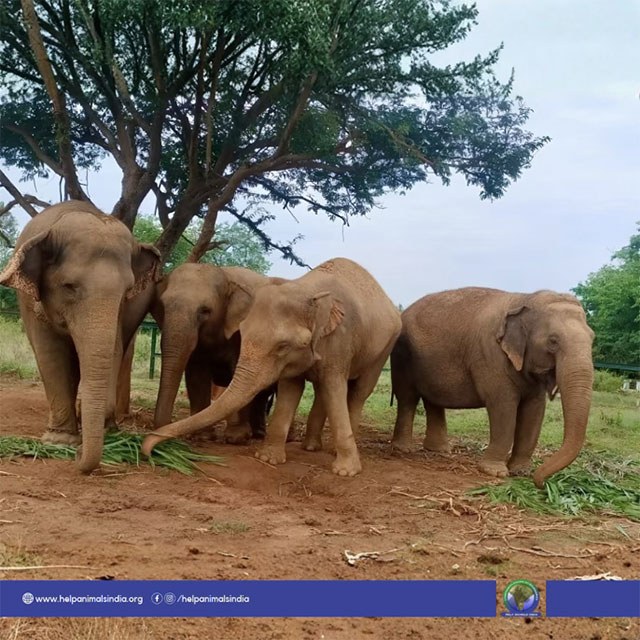
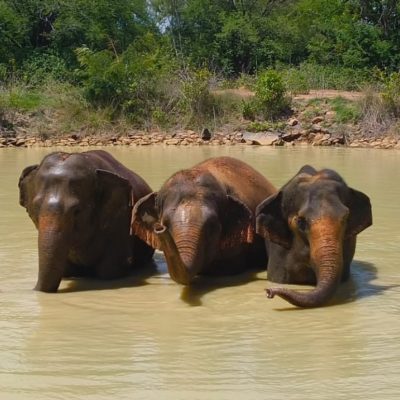
For years, the elephants now living at the Elephant Care Facility (ECF) of the Wildlife Rescue and Rehabilitation Centre (WRRC) lived in chains. They stood on concrete or hard-packed earth, were fed by hand at fixed times, and were often kept apart from other elephants. Some worked in temples and processions, walking on hot tar roads for hours.
In the wild, elephants spend up to 18 hours a day on the move, browsing on grasses, leaves, bark and branches and choosing what to eat. They live in close family groups, touching, rumbling and looking out for one another.
At the ECF, the rescued ladies are slowly getting that life back. With the help of Help Animals India and others, they now wander through open scrub and grassland, pull down branches and graze where they choose. No one decides when they eat or where they stand. After years in captivity, each one is relearning, at her own pace, how to be an elephant.
Caring for one rescued elephant costs about $2100 (₹1,85,000 ) a month.
Help give them the life they were always meant to have
A Safe Place to Heal in Dehradun
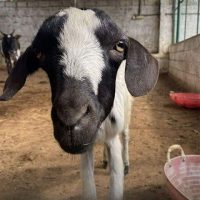
Shanu was 10 days old when she was found, fighting an infection, with a slaughterhouse waiting at the end of it. Someone reached her in time. Today she lives at Happy Home Sanctuary, run by People for Animals (PFA) Uttarakhand in Dehradun, where she spends her days exploring, pulling leaves off branches and being entirely herself. With the help of Help Animals India and others, PFA Uttarakhand has committed to food, shelter and veterinary care for Shanu and the other rescued animals there for the rest of their lives.
Across town, Raahat Animal Hospital is building for the future. A rescue is only the beginning: what follows is treatment, recovery and a safe place to stay until an animal is well. Help Animals India is proud to support Raahat as it adds more room for treatment, safer housing and proper isolation areas, so the team can care for many more street and working animals in the hills of Uttarakhand.
Raahat has also been using an ultrasound scanner to find out what is wrong with animals who come in sick or injured. Animals can't tell us where it hurts. A scan lets the team see internal injuries, swallowed objects or pregnancy complications within minutes, without surgery or guesswork, so the right treatment starts sooner.
Help us support the sanctuaries and hospitals that keep rescued animals safe
Water for a Dry Season in Puttaparthi
This year, El Niño has brought very little rain to Puttaparthi in Andhra Pradesh, and Karuna Society for Animals and Nature (Karuna Society) is preparing for a severe drought. Rather than wait for the taps to run dry, the team planned ahead. With support from Help Animals India, Karuna Society now has its own water tanker.
The tanker will keep water flowing to all four of Karuna Society’s shelters and to its plantation work, and it lets the team respond quickly to emergencies as the drought sets in.
Karuna Society’s care doesn’t stop at its own gates. The Forest Department has dug saucer pits in the surrounding forests to hold water for wildlife, but without rain, they sit empty. The team plans to use the tanker to fill them and to bring water to wildlife and to domestic animals in and around Puttaparthi wherever it’s needed.
In a drought, water is the difference between an animal getting through the summer and not. Karuna Society wanted to say thank you, and we’re grateful to them for thinking ahead.
Help Karuna Society care for animals through the dry months
Teaching Kindness, One Child at a Time
Between July and September, Stray Relief and Animal Welfare (STRAW India) ran 186 humane education workshops for 10,085 students in Bangalore, Bhopal, Delhi, Hyderabad and Kanpur. With the help of Help Animals India and others, including CHAL USA, the team taught children how to read a dog's body language, why you never tease or throw stones at an animal, and what to do when you find one hurt. STRAW India also vaccinated 144 community dogs and cats against rabies, and its educational content reached 189,000 accounts online.
In Varanasi, children who took part in a VFA outreach session went home holding leaflets about understanding and caring for street dogs. Compassion is the greatest virtue we can teach our children, and they take it home to their families, their friends and the street outside.
A child who learns kindness early grows up to protect animals. In the long run, that means fewer bites, less cruelty, and more people willing to step in.
Help us fund humane education for more children in India
Five Years in the Hills of Kalimpong
Between April 2021 and March 2026, Darjeeling Goodwill Animal Shelter (DGAS) treated 26,234 animals as outpatients in Kalimpong. That includes dogs and cats, and also goats, cows, pigs, chickens and any other animal that needed help.
In the same five years, with the help of Help Animals India and others, DGAS sterilised 6,133 dogs and 1,523 cats, vaccinated 7,065 animals against rabies, rescued 1,124 animals in distress and found homes for 520. In a hill town where many families depend on their animals, a working clinic within reach makes a real difference.
Here's to the next five years.
Help keep DGAS caring for animals in the hills
Speaking Up for Animals
In October, the Government published draft rules (G.S.R. 864(E)) to replace the protections for laboratory animals that have been in place since 1998. If they go through, labs could source animals from open markets, sign off most experiments themselves, and drop requirements for anaesthesia, pain relief and lifelong aftercare. We wrote an objection anyone could send in two minutes, and asked you to send it before the 5 November deadline. Thank you to everyone who did. Every objection adds to the record the Government has to consider, and we will share what happens next.
There was good news from Keralam, the South Indian state formerly known as Kerala, too. For years, the state's response to street dogs was known for calls to cull them. Adat grama panchayat in Thrissur has drawn up a humane plan instead: feeding stations in every ward, sterilisation and anti-rabies vaccination for community dogs, a shelter for dogs who are injured, sick or aggressive, adoption drives, and licensing and microchipping for pet dogs. It is early days, and a plan is only as good as its follow-through. But Adat shows that a local body can choose care over culling.
Help us keep speaking up for animals
Thank You
Every rescue, surgery and lesson in these pages happened because people like you care and chose to help. Thank you for standing with the animals of India and Nepal.
Follow our work on Instagram and Facebook at @helpanimalsindia.
With love and determination, The Help Animals India Team